M1E3 Abrams: US Army Begins Operational Testing of Next-Generation Tank — Five Years Early
The United States Army is about to put the first M1E3 Abrams prototypes into the hands of soldiers for operational testing this summer — a full five years ahead of the original 2032 timeline. Four prototypes in what the Army calls a “transitional configuration” will be delivered to the 1
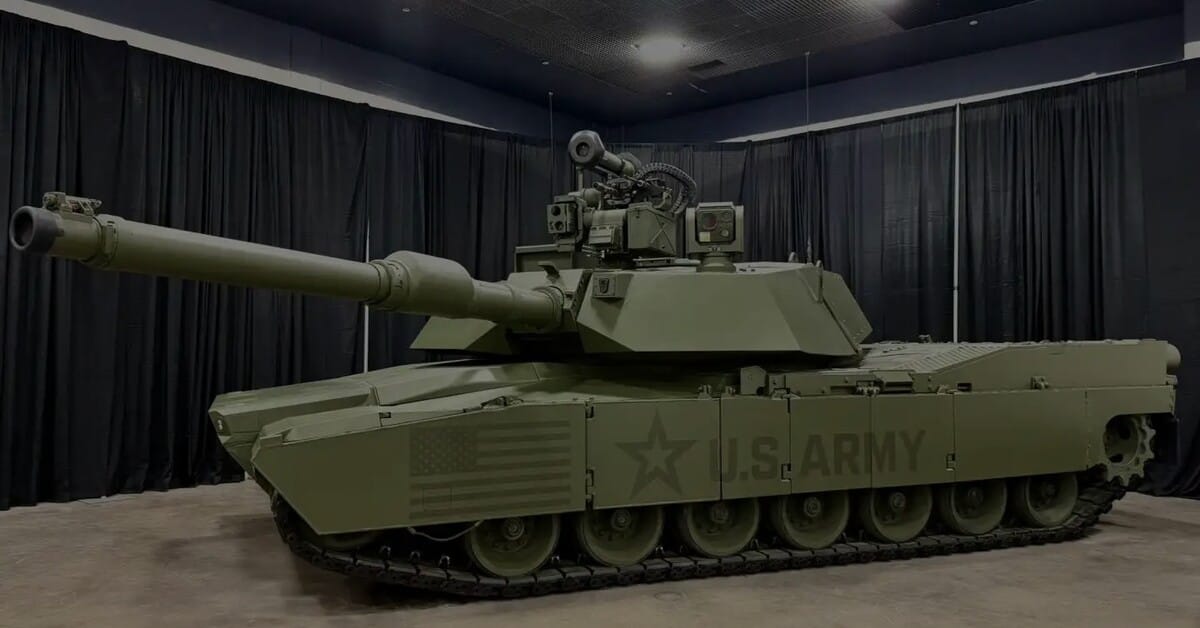
The United States Army is about to put the first M1E3 Abrams prototypes into the hands of soldiers for operational testing this summer — a full five years ahead of the original 2032 timeline. Four prototypes in what the Army calls a “transitional configuration” will be delivered to the 1st Cavalry Division, marking one of the most aggressive fielding schedules in modern armor history.
From Detroit Auto Show to the Field in Six Months
The M1E3 prototype was first publicly unveiled at the Detroit Auto Show on January 14, 2026, a deliberately unconventional venue for a main battle tank. Built by Roush Defense in Warren, Michigan, with General Dynamics Land Systems handling production planning, the demonstrator gave the first real look at the Army’s vision for armor in the 2040 era.
What made headlines was the Army’s admission that the prototypes would be up to 20 percent incomplete. Missing components will be integrated later as they become available — a deliberate strategy to get hardware into soldiers’ hands fast rather than waiting for a perfect 100 percent solution that arrives too late.
As Danny Deep, Executive Vice President for Global Operations at General Dynamics, put it: “The 90 percent solution is a much better answer than an ideal 100 percent solution that is so long from now that it isn’t going to be relevant when you get it anyway.”
Industrial Revolution: The Modular Open Systems Approach
Perhaps the most significant shift under the M1E3 program is the abandonment of the traditional single-prime-contractor model. More than ten companies are delivering subsystems under the Modular Open Systems Approach (MOSA), a plug-and-play architecture that allows rapid hardware and software swaps in the field.
The supplier list reads like a cross-section of industrial and automotive engineering:
- Caterpillar — supplying a commercial inline diesel engine to replace the aging gas turbine
- SAPA — ACT1075LP transmission
- Recaro — crew seating
- Roush — crew compartment design
- Rheinmetall (US subsidiary) — lightweight tracks
- Moog — next-generation slip ring
- General Dynamics — Abrams hull for conversion
The engine story is especially telling. The current Abrams gas turbine costs upwards of $1 million per unit with limited parts availability worldwide. The new Caterpillar commercial diesel, by contrast, can be serviced at any Cat dealership for under $10,000 per repair. Colonel Ryan Howell, Acting Deputy Program Executive Officer for Ground Combat Systems, summed it up bluntly: “I don’t need bespoke manufacturing.”
From Gas Turbine to Diesel-Hybrid
The move to a commercial diesel engine is just the first step. A hybrid-electric drivetrain is planned for the production M1A3, offering significantly better fuel economy than the legendary but thirsty AGT1500 gas turbine that has powered Abrams tanks since the 1980s. This represents a genuine green shift in heavy armor — better fuel logistics, reduced thermal signature, and lower lifetime operating costs.
Unmanned Turret and the Crew of Three
The M1E3 prototype features an unmanned turret with an autoloader, reducing the crew from four to three. All three crew members sit in the hull, with two forward hatches replacing the traditional single driver hatch. The 120mm M256 smoothbore main gun is retained, fed by a new bustle autoloader at the rear of the turret.
In demonstration mode, the tank can move and fire with a single crew member on board — a capability made possible by software-defined reconfigurable crew stations.
Gaming Controller Meets Main Battle Tank
One of the most talked-about features is the Fanatec Formula V2 gaming controller serving as the primary driver input. The Army says the commercially available controller significantly reduces driver training time, adapting to a generation more familiar with gaming hardware than tank controls. Combined with full 360-degree situational awareness via external cameras and sensors, the M1E3 represents a fundamental rethink of how a tank crew interacts with their vehicle.
App-Based Upgrades and Drone Defense
New capabilities will be delivered as software updates — app-based upgrades that soldiers install in the field, eliminating the days or weeks of downtime required for depot returns. The EOS R400 Mk2 remote weapon station on the turret roof is modular and configurable, shown with a 40mm Mk19 automatic grenade launcher, 7.62mm machine gun, and FGM-148 Javelin missile launcher. An EchoGuard radar provides counter-drone capabilities.
What’s Next
The four prototypes heading to 1st Cavalry Division this summer will validate the transitional configuration and help the Army select optimal solutions for the production M1A3, targeted for the end of this decade. With the MOSA architecture, the tank can evolve continuously — swapping in new sensors, armor packages, or power systems as threats and technologies change.
The M1E3 program is a radical departure from decades of tank procurement tradition. Faster, cheaper, more modular, and built by an industrial consortium rather than a single prime — it may well set the template for how heavy military hardware is developed for decades to come.