
Seven Liebherr Tower Cranes Tackle Twin-Bridge Replacement on Switzerland's N16
A constrained valley corridor between motorway, railway, and river demands precision lifting as Walo Bertschinger AG replaces two bridges on the N16 Transjurane national road with a fleet of seven Liebherr tower cranes.
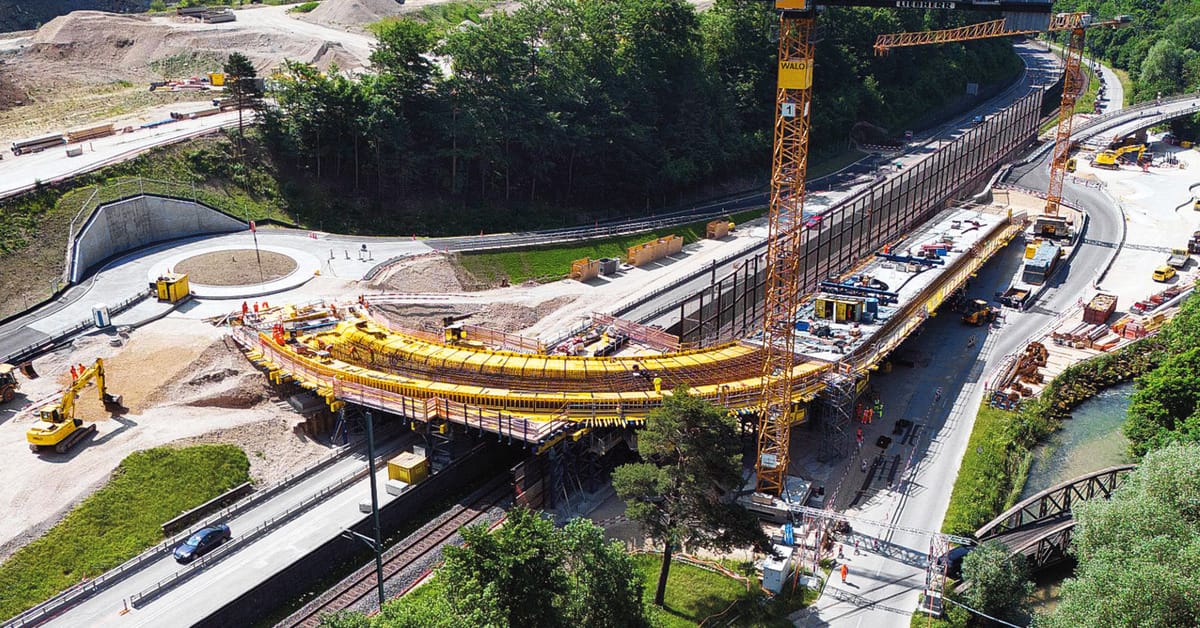
In the Bernese Jura, Walo Bertschinger AG is undertaking a dual-bridge replacement on the N16 national road connecting Tavannes and Biel, working on behalf of the Swiss Federal Roads Office (FEDRO/ASTRA). The project, which began in July 2024 and is scheduled for completion by December 2026, faces severe spatial constraints: the construction site sits wedged between a live motorway, an operational railway line, and a river, with the two existing bridges immediately adjacent to the work area.
A Tight Corridor for Heavy Construction
The N16 — part of the Transjurane motorway linking the canton of Jura with the Swiss Mittelland — is a critical infrastructure artery carrying traffic through the narrow valley floor. The replacement of bridge D19 and construction of the new D19A bridge must proceed while keeping both road and rail traffic operational.
The valley location imposes strict logistical limitations. Only a limited number of lorry deliveries can reach the site each day, meaning every lift must be meticulously planned in advance. This makes efficient crane operations not just a convenience but a prerequisite for keeping the project on schedule.
The Crane Fleet
Between 2024 and 2026, a total of seven Liebherr cranes have been deployed across different construction phases:
For the D19 bridge (2024–2025), a 270 EC-B 12, a 90 EC-B 6 flat-top crane, and a 65 K self-erecting crane handled material and component logistics. An L1-32 was also deployed for the D333 span in 2024.
For the D19A bridge (2025–2026), the same 270 EC-B 12 and 90 EC-B 6 returned, joined by an 81 K self-erecting crane.
Because both bridges are being constructed using in-situ concrete, the cranes carry out a continuous choreography of material handling: precise installation of steel girders for the falsework, positioning of timber formwork systems, placement of reinforcing bars, and hoisting of auxiliary and assembly structures.
Falsework Without Intermediate Support
One of the most technically demanding aspects of the project was the erection of the falsework — the temporary steel structure that supports the bridge section during concrete pouring. The falsework spans 22 metres and had to be erected without any intermediate support, requiring precise coordination between crane operators and on-site engineers to place components within tight tolerances.
Working Under Railway Safety Protocols
The site's immediate proximity to an operational SBB railway line adds another layer of complexity. Crane operating methods and reach had to be adapted to SBB's strict safety requirements, including the use of a telescopic crane positioned directly on the track for certain operations. Parts of the work are carried out under night-time and weekend closures, with bespoke formwork for exposed concrete work and both small- and large-scale drilling operations inside and outside track and carriageway areas.
"On a construction site bordered by a railway line and a motorway, every movement counts," says Antonio D'Onofrio, Project Manager, ppa. at Ingenieurbau West, Walo Bertschinger AG. "With the Liebherr tower cranes, we can position the structural elements precisely and safely even under these cramped conditions and keep to our construction schedule as planned."
With completion targeted for December 2026, the N16 bridge replacement stands as a textbook example of how careful crane selection and precise operational planning can overcome extreme spatial constraints in modern infrastructure construction.