No Drivers Required: How Autonomous Heavy Equipment Is Reshaping Mining and Construction Right Now
If you are picturing a construction site of the future — robots moving silently in the dark, no hard hats in sight — you are probably thinking too far ahead. The reality is less cinematic and more interesting. Autonomy in heavy equipment is not a technology waiting to happen. It has been hauling iron ore in Western Australia since 2012, driving itself through Canadian oil sands, and excavating solar pile holes in the American Midwest without a human in the cab.
What changed in the last two years is the speed and breadth of deployment. The numbers are definitive. Caterpillar ended 2024 with 690 autonomous haul trucks operating under its Command for hauling system and has set a target of more than 2,000 by 2030. Komatsu's FrontRunner system passed 875 autonomous trucks commissioned by mid-2025 and reached its 1,000th ultra-class autonomous haul truck in early 2026. These are not pilots. They are production fleets that have moved over ten billion metric tons of material autonomously.
But mining is only part of the story. Construction — the sector that builds roads, bridges, solar farms, and pipelines — is where autonomy is accelerating fastest in 2026, driven by a mix of retrofit technology and on-site AI software that has nothing to do with the machines themselves.
Caterpillar Command: The Mining Autonomy Benchmark
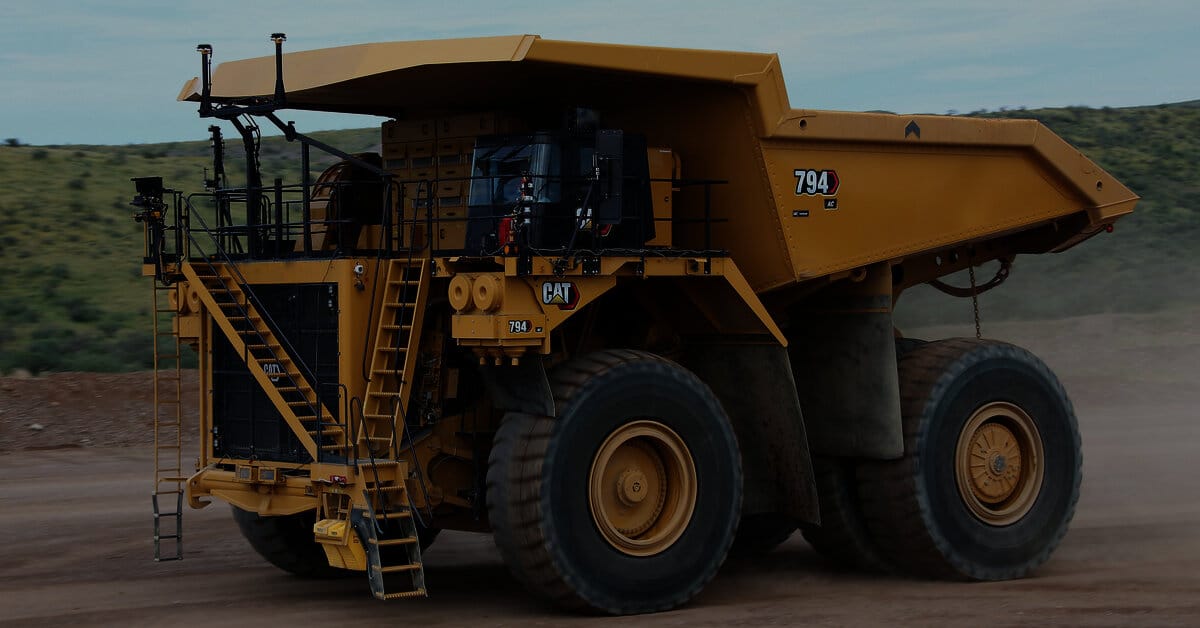
Caterpillar's autonomous haulage system, Cat MineStar Command for hauling, remains the most widely deployed system in hard-rock and open-pit mining. The system began commercial operations at Fortescue's FMG Solomon hub in Western Australia in 2012, making Fortescue the first company globally to adopt autonomous haulage at scale. That relationship was extended again in March 2026, covering three of Fortescue's mining operations in the Pilbara.
Cat Command covers hauling, dozing, and drilling — three of the four core cycles in a surface mine. The system combines machine-mounted sensors, GPS waypoint navigation, and a central dispatch command center that can operate entire fleets from thousands of kilometers away. Vehicle health monitoring, collision avoidance, and speed harmonization are built into the software layer, not bolted on afterward.
The fleet is growing fast. From roughly 100 autonomous Cat trucks in 2017, the company passed 500, then 690 by end of 2024. In November 2025, Cat's Resource Industries President Denise Johnson stated the goal of tripling that number within this decade. The expansion is not limited to giant mines. Cat began a quarry autonomy pilot with Luck Stone in Virginia in 2024, and by July 2025 that single site had moved one million metric tons autonomously with a fleet of Cat 777 trucks. For quarries — which make up a far larger addressable market than mega-mines — that is an important proof point.
In Brazil, Vale is expanding its autonomous fleet at the Carajás complex to approximately 90 trucks by 2028, using a mixed-fleet autonomy solution that Cat has developed to handle both its own trucks and competitor equipment. The flexible commercial model converts what was traditionally a capital purchase into an operational cost structure, lowering the barrier to entry for operators who are not ready to bet the mine on autonomy.
Komatsu FrontRunner: 1,000 Trucks and Counting
Komatsu's FrontRunner Autonomous Haulage System is the direct competitor to Cat Command, and the race is close. FrontRunner launched in 2008 and has since been deployed across 23 mine sites in five countries, hauling more than ten billion metric tons of material. In early 2026, Komatsu became the first OEM to commission 1,000 autonomous ultra-class haul trucks — a 930E-5AT at Barrick's Nevada Gold Mines in the United States.
The system is used by Rio Tinto, BHP, and Suncor, among others. At Suncor's Base Plant in the Athabasca oil sands, 140 Komatsu 980E trucks have operated under FrontRunner control, with another 47 at Fort Hills. The oil sands environment — extreme cold, abrasive materials, and complex haul routes — has served as a brutal proving ground for the technology.
Komatsu's integration strategy goes beyond the trucks themselves. Its FrontRunner platform is designed to interoperate across OEM boundaries and tie into the broader Modular Mining DISPATCH fleet management system. In 2025, Komatsu achieved an industry first by autonomously operating a haul truck connected to a dynamic trolley line — transferring electric power to a moving, driverless truck. This milestone puts FrontRunner on the path toward zero-emission autonomous haulage, combining battery-ready electric drive trucks with autonomy in a single system.
For the construction sector, Komatsu's Smart Quarry initiative launched in August 2025 with formal autonomy capability, powered by Pronto's autonomous haulage stack. It targets medium-sized quarries — the kind of operation that cannot justify the infrastructure spend of a mega-mine but wants the same safety and efficiency gains that autonomy delivers.
Built Robotics: Retrofitting Autonomy onto Everyday Excavators
The most interesting shift in construction autonomy is happening not with new machines, but with old ones. Built Robotics, a San Francisco-based company, has developed the Exosystem: a retrofit kit that turns a standard excavator into a fully autonomous machine. The system is an all-weather enclosure containing 360-degree smart cameras, RTK GPS with sub-centimeter accuracy, inertial measurement units, a vertical laser rangefinder, and a liquid-cooled computer. The operator's cab no longer needs an operator.
The Exosystem connects to Everest, a cloud-based command center that allows a single supervisor to monitor and manage multiple autonomous machines from anywhere. Built's primary market so far has been utility-scale solar construction, where autonomous excavators drive piles into the ground at high precision for hours at a stretch. In September 2025, Blattner — one of the largest solar contractors in North America — selected Built's autonomous pile drivers for its solar projects. The machines can run 24 hours a day if needed.
Built's safety architecture is worth noting. The system uses an eight-layer safety stack with machine learning models trained on over a million images to detect workers near the robot. The enclosure tolerates temperatures from -40°C to 55°C. Maximum pile capacity is 224 piles per setup, with a payload of up to 22,000 pounds.
The retrofittable approach is a significant advantage. A fleet owner does not have to buy new autonomous machines. They can take an existing excavator, install the Exosystem, and have it working autonomously on a solar farm the same week. For contractors who run mixed fleets of Caterpillar, Komatsu, Hitachi, and Volvo machines, that interoperability matters.
Civils.ai: Autonomy Beyond the Machine
Autonomy in heavy construction is not only about hardware. A growing layer of AI software is automating the administrative and engineering workflows that surround the machines. Civils.ai, an Australian platform, uses generative AI to process construction documents — plans, geotechnical reports, specifications, and contracts — and extract structured data for quantity takeoffs, risk assessments, and bid proposals.
For a contractor bidding on a highway project, the traditional process involves a team of estimators digging through hundreds of pages of documentation over several days. Civils.ai can produce a draft quantity takeoff in minutes: areas and volumes by zone, wall and partition lengths by construction type, counts of doors, windows, and fixtures, and linear measurements for MEP runs. The estimator reviews and adjusts the output, but the heavy lifting is done by the AI.
The platform also supports no-code workflow automation for tender preparation, contract review, and compliance checks. It represents a category of construction AI that has arrived alongside autonomous hardware but operates invisibly — in the back office, not on the jobsite. The combined effect matters: autonomous machines move dirt, and autonomous software moves paperwork, and together they are shrinking both the labor footprint and the timeline of a construction project.
Where Autonomy Stands in Mid-2026
The question is no longer whether autonomous heavy equipment works. Caterpillar and Komatsu have proven it at scale in mining, with fleets measured in hundreds and material volumes measured in billions of tons. Built Robotics has proven it in construction, with autonomous excavators working production shifts on solar installations across the United States. Civils.ai and platforms like it are proving that AI's role in construction extends well beyond the machine itself.
What is changing now is the market structure. Autonomy is moving from mega-mines into quarries, from solar farms into general earthmoving, from remote Australian pits into European and North American construction sites. The cost per ton hauled, the return on retrofit kits, and the time savings on administrative workflows are being measured and published. The data is public. The economics are becoming hard to argue with.
For fleet managers and procurement officers in 2026, the practical question is shifting from "should we try autonomy?" to "where does it make sense first?" The answer, increasingly, is that there are fewer places where it does not.