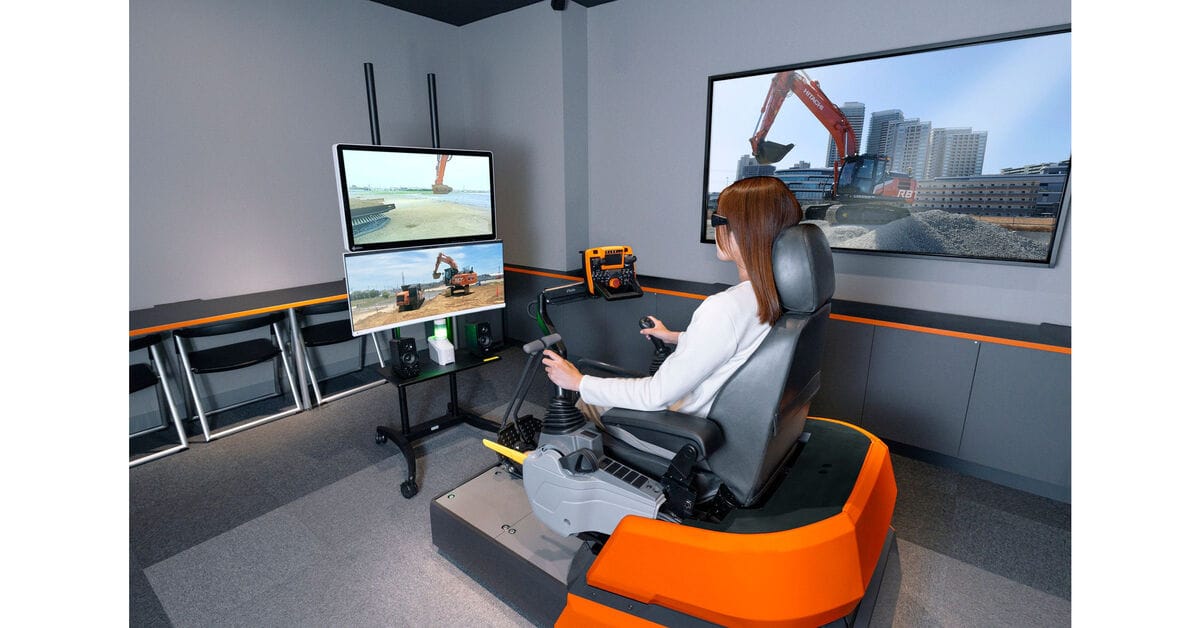
Hitachi Construction Machinery and Fukudome Kaihatsu K.K. launched a joint demonstration test of remote construction using a real-time digital twin platform on June 1, 2026, at a river channel dredging site in Kochi Prefecture, Japan. The two-month trial runs through July 31, 2026, and involves a ZX200A-7 20-tonne class hydraulic excavator operated remotely through a 3D virtual replica of the entire worksite.
Beyond Camera-Only Remote Operation
Conventional remote construction relies on camera feeds mounted on the machine itself. While functional, this approach gives the operator a limited, fixed viewpoint — similar to looking through a keyhole. The operator loses the broader situational awareness that an on-site operator would have: terrain changes, the position of other vehicles, and the movement of workers around the machine.
Hitachi's real-time digital twin platform addresses this by collecting and integrating data from multiple sources — 3D terrain scans, machine telemetry, vehicle and worker positioning — and reproducing the entire worksite in a shared 3D virtual world. The operator sees not just what the excavator's cameras show, but a complete, live representation of the construction site from any angle.
This approach builds on development work Hitachi began in 2024, when the company first demonstrated the platform in cooperation with IoT specialist aptpod and 3D terrain software developer Unicast. The platform later expanded to include Vectology's Accuvision panoramic vision system, which provides a 360-degree view around the excavator.
Three Verification Objectives
The demonstration is structured around three verification targets:
Safety and productivity. The project will measure whether the digital twin platform enables safer and more productive remote excavation compared to existing methods. Real-time monitoring of 3D terrain, camera imagery, and location data for machinery, vehicles, and personnel is intended to give the remote operator the same — or better — situational awareness as someone sitting in the cab.
Method comparison. The test compares three operational conditions head-to-head: direct visual observation from the site (the traditional baseline), remote operation using camera images alone (the current standard), and remote operation using the real-time digital twin platform. This three-way comparison is designed to quantify exactly what the digital twin adds.
Information sharing and decision support. Beyond the operator's view, the platform streams site data to remote managers and support personnel, enabling informed decisions about scheduling, machine allocation, and safety from a separate location. The goal is to demonstrate that a digital twin can serve as a single shared source of truth across the entire project team.
Technology Partners
The platform relies on three specialized technology partners:
- aptpod, Inc. provides the cloud infrastructure and user interface based on its intdash high-speed IoT platform, which streams large volumes of time-series data with low latency.
- Vectology, Inc. contributes the Accuvision panoramic vision system, giving the operator a 360-degree view of the excavator's surroundings.
- Unicast Inc. supplies the software that converts terrain survey data (including LiDAR) into the 3D model that forms the digital twin's environmental foundation.
Fukudome Kaihatsu, a community-based construction firm in Kochi Prefecture with extensive experience in ICT construction and 3D surveying, provides the worksite and handles the on-site safety and productivity evaluations.
The Bigger Picture: Labor Shortage Driving Automation
Japan's construction industry faces a structural labor shortage. The Ministry of Land, Infrastructure, Transport and Tourism (MLIT) has reported a more than 20 percent decline in the construction workforce over the past decade, while infrastructure maintenance demands continue to rise as public assets age. Remote construction and autonomous machinery are increasingly seen as essential tools for bridging this gap, not optional experiments.
Hitachi Construction Machinery has been developing autonomous and remote operation technologies since at least 2020, when it launched the ZCORE system platform. The 2023 capital and business alliance with aptpod accelerated the digital twin work, and the company now plans to use insights from this demonstration to refine the platform further. The stated long-term goal is a "next-generation construction site where people and machinery work in a coordinated manner."
If the Kochi demonstration proves successful, it could pave the way for broader adoption of digital twin-based remote construction across Japan — and potentially set a template for how the industry approaches the twin challenges of safety and workforce scarcity.
Sources
- Hitachi Construction Machinery — Press Release: Joint Demonstration Test of Remote Construction Utilizing a Real-Time Digital Twin Platform — published 28 May 2026
- Hitachi Construction Machinery — Press Release: Develops "Real-Time Digital Twin Platform" That Reproduces the Real Construction Site in a Virtual World — published 9 May 2024
- Hitachi Construction Machinery — Press Release: Signs Capital and Business Alliance Agreement with Japanese IoT Startup Aptpod — published 22 May 2023