Fortescue Trials Electric Mining Fleet, Including 150-Tonne Battery Water Truck
Published July 24, 2026
Fortescue, one of the world's largest iron ore producers, is trialing a zero-emission electric mining fleet at its Pilbara operations in Western Australia — a critical proving ground for the company's ambitious plan to eliminate diesel from its mining operations by 2030.
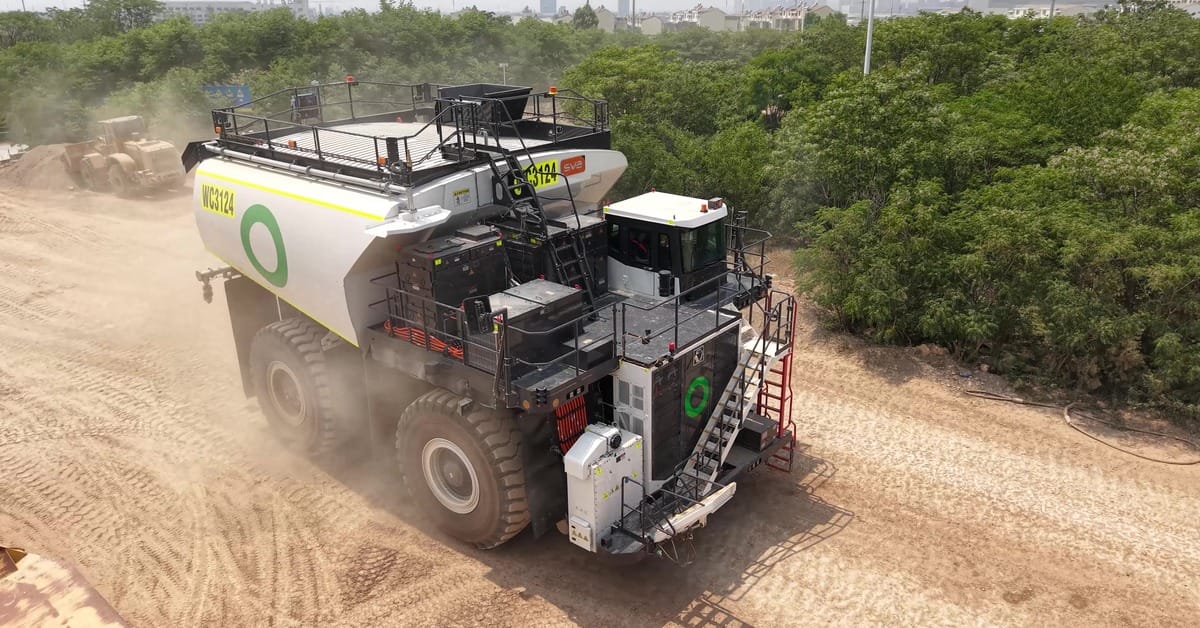
Among the vehicles in the trial is a 150-tonne battery-electric water truck, purpose-built for dust suppression on mine haul roads. Water trucks are among the most challenging vehicles to electrify because they run near-continuously during operating hours, carry heavy payloads of water, and operate on steep, uneven haul roads. A successful electric water truck at this scale would represent a significant milestone for off-road vehicle electrification.
Fortescue's broader trial fleet includes battery-electric light vehicles, service trucks, and haulage equipment, deployed across its mining operations as part of a phased transition away from diesel. The company is targeting full decarbonisation of its mobile mining fleet under its "Real Zero" strategy, which rejects carbon offsets in favour of eliminating emissions at source.
The 150-Tonne Electric Water Truck
The 150-tonne electric water truck is a conversion of Fortescue's existing ultra-class water cart platform, replacing the diesel powertrain with a battery-electric system. While Fortescue has not released full technical specifications, the truck is expected to draw on the same high-capacity battery technology being developed for its heavy-haul truck programme.
Electrifying water trucks is a particular focus because water carts are among the highest-utilisation vehicles on any mine site. They run throughout operating shifts to control dust on haul roads, a task that becomes more demanding in drier conditions. A single diesel water truck can consume up to 80,000–100,000 litres of diesel annually. Eliminating that consumption — across a fleet of dozens of trucks — represents a material contribution to Fortescue's Scope 1 reduction target.
The truck has been tested under real operating conditions at Fortescue's mine sites in the Pilbara, putting the battery system, thermal management, and regenerative braking through their paces on production haul roads.
Electrification Beyond the Water Truck
Fortescue's fleet electrification strategy spans multiple vehicle classes. The company has been developing battery-electric haul trucks in partnership with Liebherr, including the Liebherr T 264, a 240-tonne class ultra-class truck being converted to battery-electric propulsion. The T 264 prototype draws on Fortescue's in-house battery system design, developed through its Fortescue Energy division.
Light vehicles and auxiliary equipment are also being electrified. Fortescue has deployed battery-electric buses for personnel transport, service trucks, and smaller support vehicles at its mine sites, reducing diesel consumption across the full mobile fleet.
The company's "Real Zero" pathway — detailed in its FY25 Climate Transition Plan — requires the complete elimination of diesel from its mining operations by 2030. That means replacing or converting a fleet of several hundred heavy haul trucks, dozens of water carts, and hundreds of light and auxiliary vehicles within less than five years. The current trials are the essential validation step before committing to fleet-wide deployment.
Implications for the Mining Industry
Fortescue's push into electric mining vehicles carries weight because of its scale. The company produced roughly 190 million tonnes of iron ore in FY2024 — one of the largest output streams in global seaborne iron ore. If Fortescue successfully transitions its mining fleet to zero-emission technology, it will create a powerful reference case for the broader mining industry.
The electrification of heavy mining equipment is accelerating across the sector. Caterpillar, Komatsu, Liebherr, Hitachi, and SANY are all developing battery-electric and hydrogen fuel cell haulage solutions. But Fortescue's vertical integration strategy — developing its own battery systems and working directly with OEMs on vehicle integration — gives it unusual control over the technology pathway.
Mining fleet electrification also intersects with Fortescue's broader energy strategy. Through Fortescue Energy, the company is developing green hydrogen production and large-scale renewable energy infrastructure that will be needed to charge and power an electric fleet at industrial scale.
For mining professionals and fleet managers watching this space, Fortescue's water truck trial is one to track closely. If the 150-tonne battery-electric water truck proves reliable in production conditions, it would remove one of the remaining technical doubts about full-fleet electrification in open-pit mining.
Sources
- Fortescue — Real Zero: Decarbonisation — Fortescue corporate website, accessed 24 July 2026
- Fortescue FY25 Climate Transition Plan (PDF) — Fortescue, published September 2025