Rheinmetall and Mercedes-Benz grow the Wolf Pack with Timber Wolf and Silver Wolf
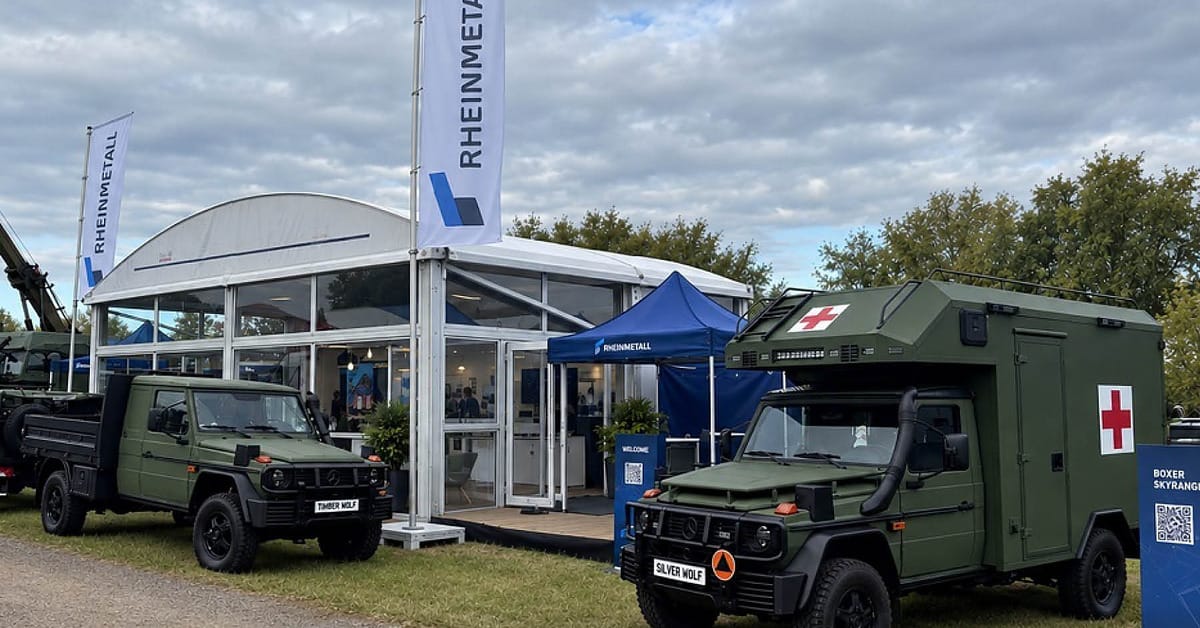
Team Wolf has grown the Wolf Pack. Rheinmetall UK and Mercedes-Benz UK unveiled two new light tactical vehicles, Timber Wolf and Silver Wolf, at the DVD 2026 land equipment exhibition at Millbrook on 17 September. They join Shadow Wolf and Caracal in the family the two companies are offering to the British Army for its Light Mobility Vehicle (LMV) requirement.
Both new vehicles are built on the military Mercedes-Benz G-Class (W464) that Team Wolf uses as its Common Base Platform. Mercedes-Benz supplies the vehicle base and its long-standing OEM expertise; Rheinmetall UK supplies military integration and mission-system capability. The companies say common chassis, systems and interfaces are intended to reduce fleet complexity and simplify training, maintenance and sustainment.
The names map onto the roles. Timber Wolf is the LMV utility vehicle (UV) variant and Silver Wolf the battlefield ambulance (BFA). Shadow Wolf, shown at DSEI 2025, is the general-purpose vehicle in the family, while Caracal is Rheinmetall's air-transportable platform for airborne and special operations, already selected by the German and Dutch armies and used operationally in Ukraine. Together the Wolf Pack covers mobility, command, ambulance, troop transport, sustainment and specialist missions from one fleet.
Engineering, integration, support and future upgrades will sit at Rheinmetall BAE Systems Land (RBSL) in Telford, confirmed as Team Wolf's Vehicle Integration Centre. Telford already builds Boxer vehicles for the British Army. Team Wolf is targeting up to 50 per cent UK content, engaging 30 British suppliers including SMEs, and promising through-life support for more than 20 years.
"The unveiling of Timber Wolf and Silver Wolf is an exciting next step for Team Wolf and demonstrates that the Wolf Pack is about much more than individual vehicles," said Rebecca Richards, managing director of Rheinmetall UK. Olivier Reppert, CEO and managing director of Mercedes-Benz Cars UK, described the G-Class as a reliable, highly adaptable vehicle foundation, and said the partnership pairs proven Mercedes-Benz technology with Rheinmetall's specialist defence expertise.
The backdrop is a competition. LMV replaces the Land Rover Wolf and Pinzgauer utility fleets, due out of service by 2030. The show itself runs at Millbrook Proving Ground on 16–17 September under MoD sponsorship, and the Team Wolf partnership was formalised the day before the two vehicles were unveiled. The tender was published on 31 July 2026 and is valued at around £2 billion excluding VAT, with options that could take the fleet beyond 9,500 vehicles across nine variants — general purpose, utility, troop carrying, battlefield ambulance, tactical mobility, command and control, equipment support, enhanced protection and mission systems. Bidders had until 1 September to request participation; the MoD plans to select no more than seven teams for dialogue and trials.
Rheinmetall is not the only bidder. Seven prospective contenders have presented vehicles publicly: Jaguar Land Rover with the Defender Wolf Series II, Ineos with the Grenadier, Babcock and Supacat with a Toyota Land Cruiser 70-based family, Team LionStrike with GM Defense vehicles, General Dynamics with Ford and Ricardo around the Ranger, and Fering Technologies with the hybrid-electric Pioneer X.
The G-Class offer sits at the premium end of that field. It is a heavier and more expensive platform than the Defender-class vehicles LMV is meant to replace, and the base vehicle is built in Austria, which puts weight on the UK content and integration arguments. Rheinmetall's answer is scale: one common base platform covering nine roles, engineered and supported in Britain, with a support arrangement measured in decades rather than a single vehicle order.
Sources
- Rheinmetall: "Rheinmetall UK and Mercedes-Benz UK advance Team Wolf partnership for the future of British Army mobility" (press release, Millbrook) — published 16. September 2026
- Rheinmetall: "Shadow Wolf – Born from the wolf pack" (product page: "with Shadow Wolf providing the General Purpose Vehicle capability"; Common Base Platform, UK adaptation and fabrication) — accessed 19. September 2026
- Joint Forces News: "Rheinmetall UK and Mercedes-Benz UK Strategic Partnership" (carries the Rheinmetall media releases of 16 and 17 September 2026, including the Wolf Pack unveiling; variant captions: Silver Wolf LMV BFA, Timber Wolf LMV UV) — published 19. September 2026
- European Security & Defence: "Rheinmetall at DVD – Team Wolf" (press release text, Millbrook, 17 September 2026; quotes from Rebecca Richards and Olivier Reppert) — published 17. September 2026
- Army Technology: "Rheinmetall UK, Mercedes-Benz formalise partnership, unveil new vehicles" (Vehicle Integration Centre at RBSL Telford, Shadow Wolf at DSEI 2025, Caracal airborne family) — published 17. September 2026
- ADS Advance: "The British Army's next Land Rover: Seven prospective LMV solutions" (tender value £2bn excluding VAT, up to 9,500 vehicles, seven publicly presented contenders, 1 September participation deadline, no more than seven teams for dialogue and trials) — published 14. September 2026
- Defence Online: "British Army's £2 Billion Light Mobility Vehicle Tender Published as Chinese Suppliers Excluded Under Procurement Act 2" (Land Rover Wolf and Pinzgauer: out-of-service date of 2030) — published 5. August 2026
- UK Contracts Finder / Find a Tender: "713718450 – Light Mobility Vehicle" (tender notice published 31 July 2026; Common Base Platform, nine variants incl. UV, BFA and TCV, fleet in excess of 9,500) — published 31. July 2026
- UNITED24 Media: "Mercedes G-Class Gets a Military Makeover in Rheinmetall's New Timber Wolf and Silver Wolf" (W464 platform designation; Silver Wolf shown in medical configuration) — published 17. September 2026