From Diggers to 350 mph: Why JCB Is Taking Hydrogen to Bonneville
Twenty years ago, JCB did something no construction equipment manufacturer had done before: it took two diesel engines off the production line, tuned them for extreme performance, and raced them to a world land speed record of 350.092 mph on the Bonneville Salt Flats. The JCB Dieselmax record still stands.
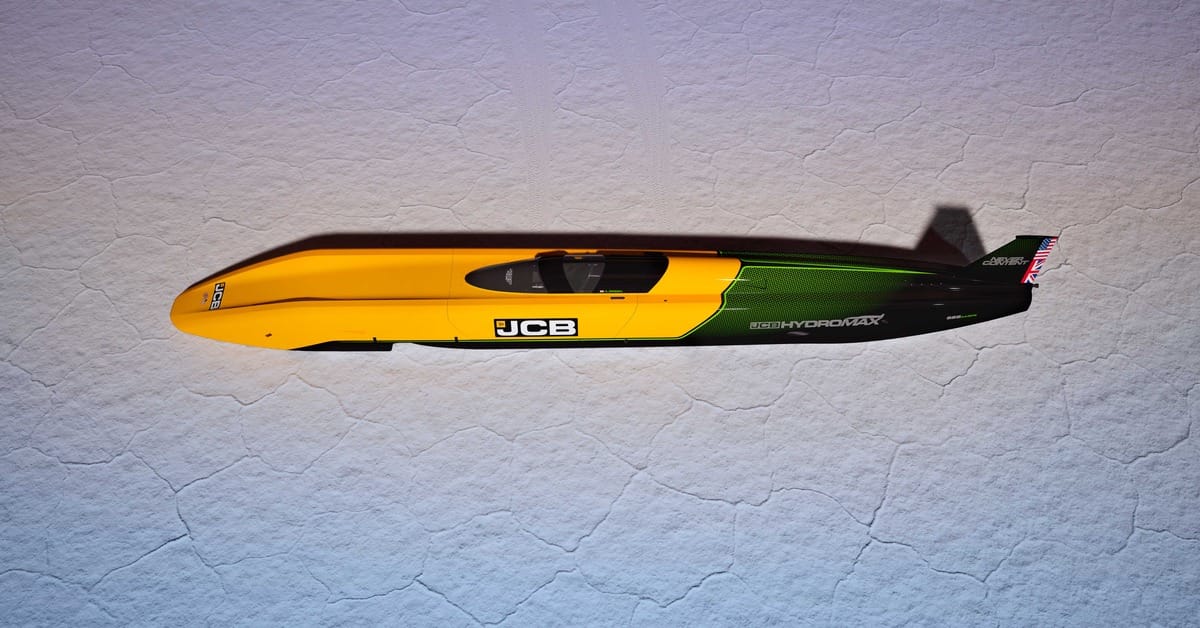
Now JCB is going back. This August, the British engineering company returns to the salt with the JCB Hydromax — a 32-foot streamliner powered by two of its own hydrogen internal combustion engines, aiming to break 350 mph and prove that hydrogen is a viable fuel for the heaviest machinery on earth.
Twin Hydrogen Engines, 1,600 Horsepower
The Hydromax is no one-off science experiment. Under its aerodynamic shell sit two production-based JCB hydrogen combustion engines, tuned to deliver approximately 800 bhp each for a combined output of 1,600 bhp. The four-wheel-drive layout uses a twin-transmission and clutch system, with all-wheel traction managed to handle the notoriously tricky surface of the Bonneville Salt Flats.
JCB has drawn on deep engineering partnerships: Prodrive is handling the car build, Ricardo contributes engine tuning (as it did for the Dieselmax in 2006), and Xtrac provides transmission expertise. The result is a car that is lighter, more powerful, and aerodynamically more efficient than its diesel predecessor — one that has already undergone stress-testing of its suspension, driveline, and stability systems in the UK ahead of the August attempt.
The Records in Sight
The immediate target is to exceed 350 mph, which would beat JCB's own 2006 diesel record. But the Hydromax is also chasing several other benchmarks:
- Hydrogen ICE record: 185.5 mph (current)
- Hydrogen fuel cell record: 303 mph (Buckeye Bullet 2, 2009)
- Electric vehicle record: 342 mph
A run above 350 mph would claim the world's fastest hydrogen-powered vehicle title outright — combustion or fuel cell. After Bonneville SpeedWeek (1–7 August, sanctioned by the SCTA), the team will remain on the salt for official FIA world record attempts.
The Man Behind the Wheel
There is no one better qualified to drive a 1,600-horsepower land speed car on salt than Andy Green OBE. The former RAF Wing Commander holds the outright land speed record of 763.035 mph from his time in Thrust SSC, making him the first and only person to break the sound barrier on land. He also piloted the JCB Dieselmax to its record in 2006.
"Twenty years ago, JCB took two of its diesel engines, sprinkled some magic engineering dust on them and put them into a racing car," Green says. "Now we're going back to the Bonneville Salt Flats, spiritual home of the World Land Speed Record, with JCB's new hydrogen engines."
Why This Matters for Heavy Industry
The Hydromax is not a publicity stunt — it is a proof-of-concept for JCB's broader hydrogen strategy. The company has invested £100 million over five years in hydrogen combustion engine development, and production hydrogen-powered excavators, backhoe loaders, and telehandlers are already rolling off assembly lines.
JCB's argument is straightforward: battery-electric works for compact and light-duty equipment, but for mid-size and heavy machinery — excavators, wheel loaders, dozers working long shifts in remote locations — hydrogen internal combustion offers a more practical zero-emissions solution. It allows fast refueling, retains the power density operators depend on, and avoids the cooling and contamination challenges that make fuel cells difficult in dusty construction environments.
"We raced the JCB Dieselmax up to an astonishing speed — and it proved a point," says JCB Chairman Anthony Bamford. "Putting an advanced engine into a land-speed car showed the world what it could do in a way a digger never could. It's the same thinking with hydrogen today."
From Dieselmax to Hydromax
JCB's racing pedigree is deeper than most realise. The company has set three land speed records in the past twelve years: the Fastrac tractor record (135.191 mph in 2019), the JCB GT backhoe loader record (72.58 mph in 2014), and the still-standing Dieselmax diesel record. Each project has served the same purpose — to stress-test production engine technology under extreme conditions.
The Hydromax continues that tradition. If it succeeds, the message to the construction industry will be unmistakable: hydrogen combustion is robust enough for the toughest environments on earth — from the salt flats of Utah to construction sites around the world.
Testing in the UK is already underway. August will tell whether JCB can add a hydrogen land speed record to its name — and whether its bet on hydrogen combustion will prove as successful as the diesel technology that powered the Dieselmax two decades ago.