
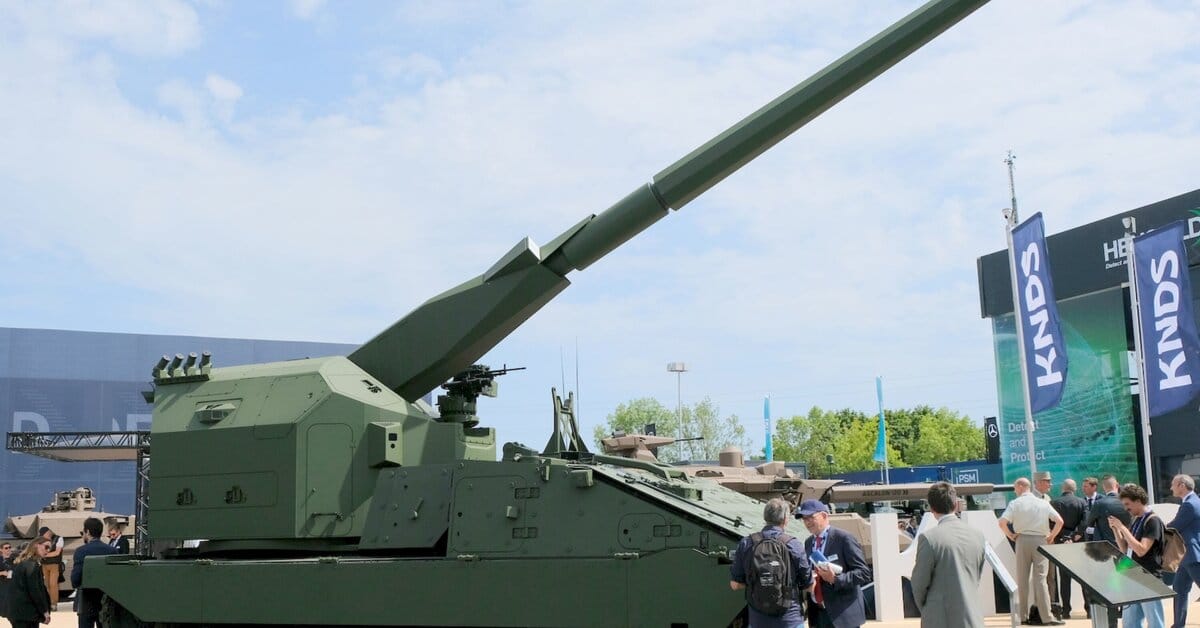
PARIS — At the Eurosatory 2026 defense exhibition this week, the Franco-German defense consortium KNDS unveiled Loras (Long-Range Artillery System), a 155 mm howitzer equipped with a 58-caliber barrel that achieves a base range of 60 kilometers using standard high-explosive shells — no rocket assistance required.
The system represents the first European artillery program to substantially exceed the 52-caliber standard that has dominated NATO tube artillery for decades. With a barrel 12 percent longer than the norm, Loras pushes conventional 155 mm artillery into a range bracket previously reserved for rocket systems such as GMLRS and M270.
Longer Barrel, Greater Reach
The 58-caliber barrel — produced at KNDS France's facilities in Bourges, central France — measures approximately 8.99 meters, compared to 8.06 meters for a standard 52-caliber gun and roughly 6 meters for the US M109 Paladin's 39-caliber barrel. The difference on the ground is significant: where a 52-caliber howitzer like the Caesar or PzH 2000 reaches roughly 40 km with conventional HE rounds, Loras extends that to 60 km.
KNDS artillery engineer Pierre Septfons told reporters at Eurosatory that the goal was to achieve this range without expensive rocket-assisted projectiles. "The objective was to be able to reach 60 kilometers with conventional munitions," Septfons said.
Lessons from ERCA and Ukraine
The US Army's Extended Range Cannon Artillery (ERCA) program attempted a similar 58-caliber configuration but was cancelled in March 2024 due to severe barrel wear after only a few hundred rounds. KNDS says it has addressed the problem with an enlarged combustion chamber that produces what the company describes as a "much gentler pressure curve" compared to ERCA's approach.
The loading mechanism is fully automatic, with a newer electronic architecture than the PzH 2000. KNDS has drawn lessons from combat experience in Ukraine, where the simpler semi-automatic Caesar has demonstrated higher battlefield availability than the more complex fully automatic PzH 2000. The company says the Loras automation design prioritizes reliability through simplified mechanics.
The system can accommodate up to eight modular propelling charges, compared to six in the Caesar, and achieves a firing rate exceeding eight rounds per minute. Combat weight is under 45 tonnes, crew requirement is two personnel, and the vehicle offers shoot-and-scoot capability with 360-degree traverse.
Ammunition and Growth Path
KNDS is developing a dedicated 58-caliber ammunition family covering high-explosive, illumination, and smoke rounds optimized for the weapon's higher muzzle velocity. The gun is fully compatible with existing NATO-standard JBMoU 155 mm ammunition, though standard rounds will not reach the full 60 km range.
The company is also open to partnerships for advanced munitions such as ramjet-powered or glide projectiles, which could push effective range toward the 100 km mark. For now, however, KNDS is focused on delivering conventional capability.
Rheinmetall has countered with its own 155 mm L/60 barrel, tested at pressures above 600 MPa, which it showed at Eurosatory on the same floor. The German company claims a range exceeding 50 km with standard projectiles and expects demonstration firings later this year. The two European approaches — KNDS emphasizing controlled barrel wear and conventional range, Rheinmetall pushing higher pressure and velocity — offer competing visions for the next generation of tube artillery.
Timeline
KNDS has already fired a prototype of the Loras. Serial production is planned for the 2032–2035 timeframe, with the project self-funded by the company following early-stage studies supported by the French defense procurement agency DGA.
Sources
- Defense News — "Size matters: KNDS pitches long-barreled artillery for 60-kilometer base range" — Rudy Ruitenberg — published 17 June 2026
- Army Recognition — "KNDS unveils LORAS self-propelled howitzer to challenge rocket launchers with 100 km range" — published 17 June 2026
- Meta-Defense — "Loras vs L60: when Europeans take on the challenge of long-range artillery barrels" — Fabrice Wolf — published 17 June 2026