
Breaking News
Samsung Heavy Industries (SHI) has chosen Liebherr to supply an RL 4600 offshore crane for the Cedar LNG floating liquefied natural gas (FLNG) facility in British Columbia, Canada, Liebherr announced on 18 June 2026.
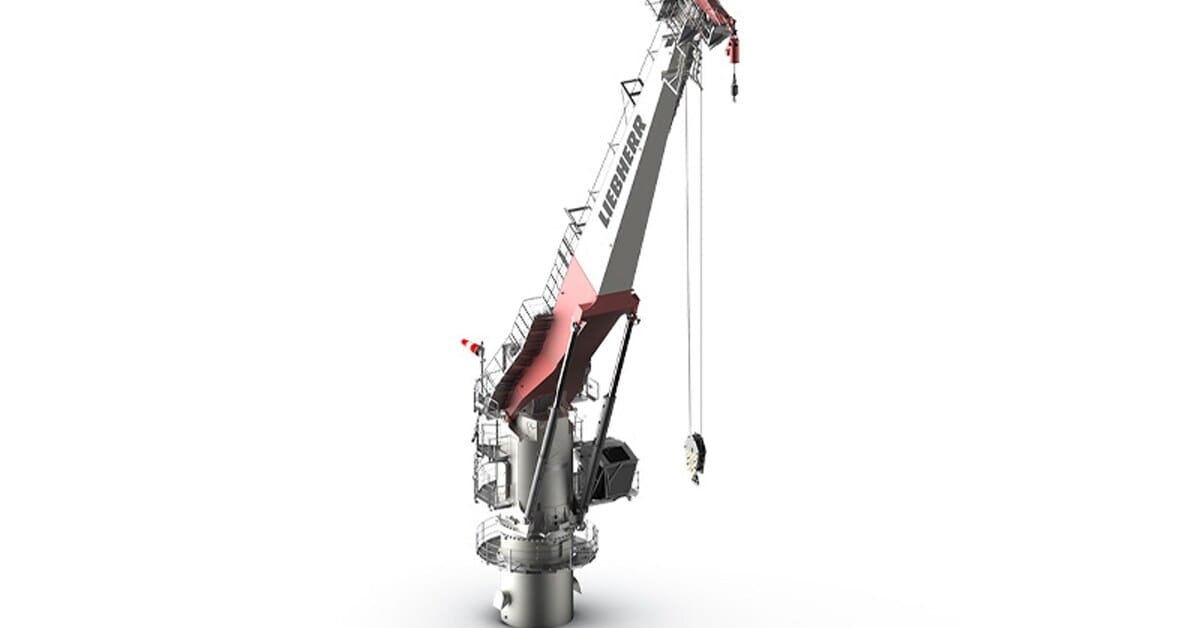
The RL 4600, with a maximum lifting capacity of 40 tonnes and a main hoist outreach of 28 metres, will be installed on the FLNG unit currently under construction at SHI's shipyard in South Korea. Liebherr Korea will oversee installation and commissioning, while Liebherr Canada will provide on-site maintenance and technical support once the crane is in service.
"The RL 4600 is an impressive piece of equipment, and we value the close collaboration with SHI on this project," said Eddie Park, Divisional Manager at Liebherr Korea.
Compact offshore design
The crane's low overall height and minimal tail swing make it well-suited for space-constrained floating platforms. Its slewing column houses the main drive system, central hydraulics, and complete control technology in a single assembly, reducing external components and simplifying maintenance. The Litronic control system delivers smooth, precise movements, continuously monitoring load and radius while automatically adjusting winch speeds.
All components are built for harsh offshore conditions — wide temperature ranges, shock loads, moisture, and saline air — with a durable multi-layer coating providing corrosion protection.
Canada offshore footprint
The contract extends Liebherr's presence in the Canadian offshore market. "We are proud to provide our RL 4600 for this important FLNG development and to extend our market footprint in Canada," said Oliver Odebrecht, Sales Manager General Purpose Offshore Cranes at Liebherr-Rostock GmbH.
One of the world's cleanest FLNG facilities
Cedar LNG, a partnership between Pembina Pipeline Corporation and the Haisla Nation, is positioned as one of the world's lowest-carbon LNG projects. The facility will be powered entirely by renewable electricity, and the Haisla Nation holds a majority ownership stake — making it the world's first Indigenous majority-owned LNG project. First LNG is expected by 2028.
Sources:
- Liebherr press release: RL 4600 extends Liebherr's offshore presence in Canada — published 18 June 2026
- Cedar LNG — Project Overview — accessed 18 June 2026