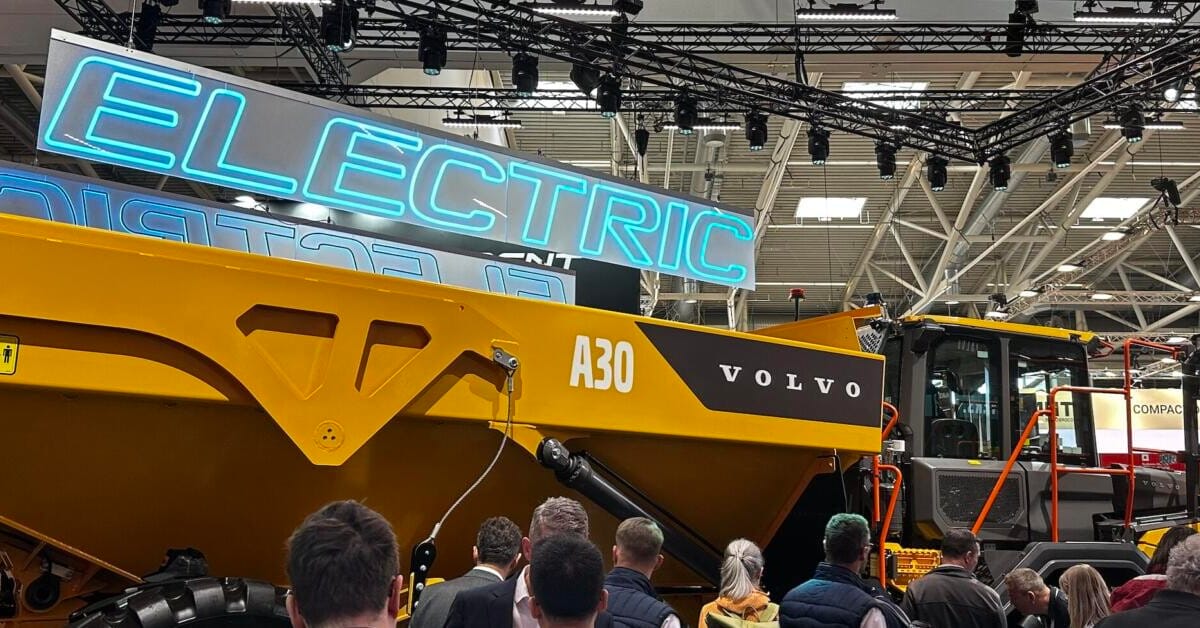
Volvo A30 Electric Deployed at Norway Hydropower Tunnel — World's First Fleet in Customer Operation
Volvo Construction Equipment has delivered the world's first production A30 Electric articulated haulers to a customer site, placing four units with Norwegian contractor LNS at Hafslund's Hemsil 3 pumped-storage hydropower project in Buskerud. Three additional machines are scheduled to arrive in July, forming the first fleet of series-produced battery-electric articulated dump trucks operating in a real-world heavy construction application.
The deployment marks a transition from prototype demonstrations to operational reality for electric haulers in the 30-tonne payload class — a segment long considered one of the hardest to electrify due to high power demands and grueling duty cycles.
Tunnel construction as a natural fit for zero emission
The seven A30 Electric units will be tasked with mucking and material transport in the construction of an approximately 20-kilometre tunnel system for the Hemsil 3 project. Tunnel environments present a uniquely strong case for battery-electric equipment: enclosed spaces amplify the problems of diesel exhaust, requiring expensive ventilation systems and exposing workers to particulate matter and NOx even with best-in-class filtration.
"The enclosed tunnel environment is exactly where zero-emission machines show their full value," said LNS project management in connection with the delivery. "Removing diesel emissions from the tunnel face improves air quality, reduces ventilation demand, and creates a healthier working environment for our crews."
Volvo CE's A30 Electric carries a payload capacity of 29 tonnes and is powered by a 450 kWh lithium-ion battery pack driving a 265 kW electric motor. The machines support CCS2 fast charging at up to 350 kW, enabling the battery to recharge from 20 to 80 percent in approximately one hour — compatible with shift-change intervals in multi-shift tunnel operations.
Built at the birthplace of the articulated hauler
All seven A30 Electric units are produced at Volvo CE's Braås facility in Sweden — the same plant that launched the original articulated hauler concept with the legendary "Gravel Charlie" in 1966. The choice of manufacturing location is symbolic: sixty years after inventing the segment, the same factory is now delivering the first zero-emission articulated haulers at industrial scale.
The Braås plant has been retooled to handle electric driveline assembly alongside conventional production, giving Volvo CE the flexibility to scale electric output as customer demand grows.
Hemsil 3 — Norway's growing pumped-storage capacity
The Hemsil 3 project is a pumped-storage hydropower plant being developed by Hafslund, one of Norway's largest power producers. Located in the Hallingdal region, the facility will add significant grid-balancing capacity to the Norwegian power system, storing energy by pumping water uphill during periods of low demand and releasing it through turbines when demand peaks.
Tunnel construction for hydropower projects is demanding work requiring round-the-clock material haulage in confined spaces — a combination that makes the shift to electric haulers both operationally logical and environmentally impactful. For LNS, a contractor with extensive experience in Norwegian hydropower and tunnel projects, the A30 Electric fleet represents an early bet on electrification in one of the construction industry's most challenging segments.
Broader implications for the industry
The Norway deployment goes beyond a single project. For fleet operators evaluating electric haulers, seeing the A30 Electric in sustained production operation — rather than controlled demonstrations — provides real-world data on runtime, charging logistics, and total cost of ownership under genuine working conditions.
Volvo CE has stated that first deliveries of the A30 and A40 Electric are underway to customers in Norway and the UK, with additional European deliveries planned for the second half of 2026. The Braås production line is now active, and the company has indicated that early customer demand has exceeded initial production expectations.
If the Hemsil 3 deployment proves successful, expect to see electric haulers appearing on tunnel and quarry projects across Europe at an accelerating pace — not just as prototypes, but as production equipment delivering measurable operational benefits from day one.