
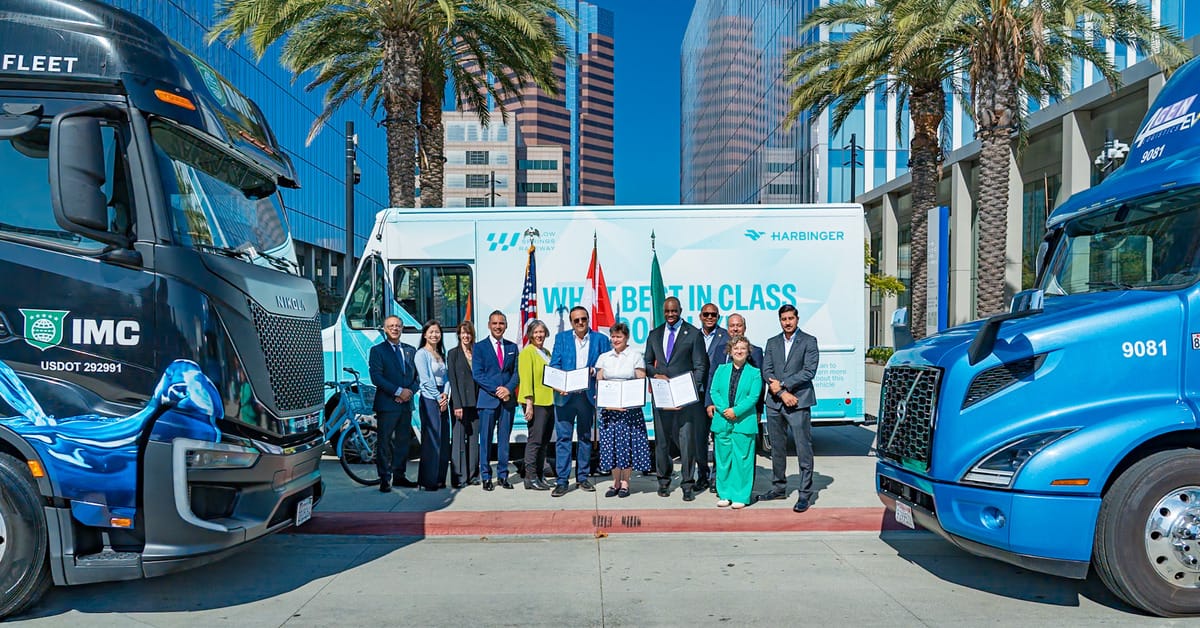
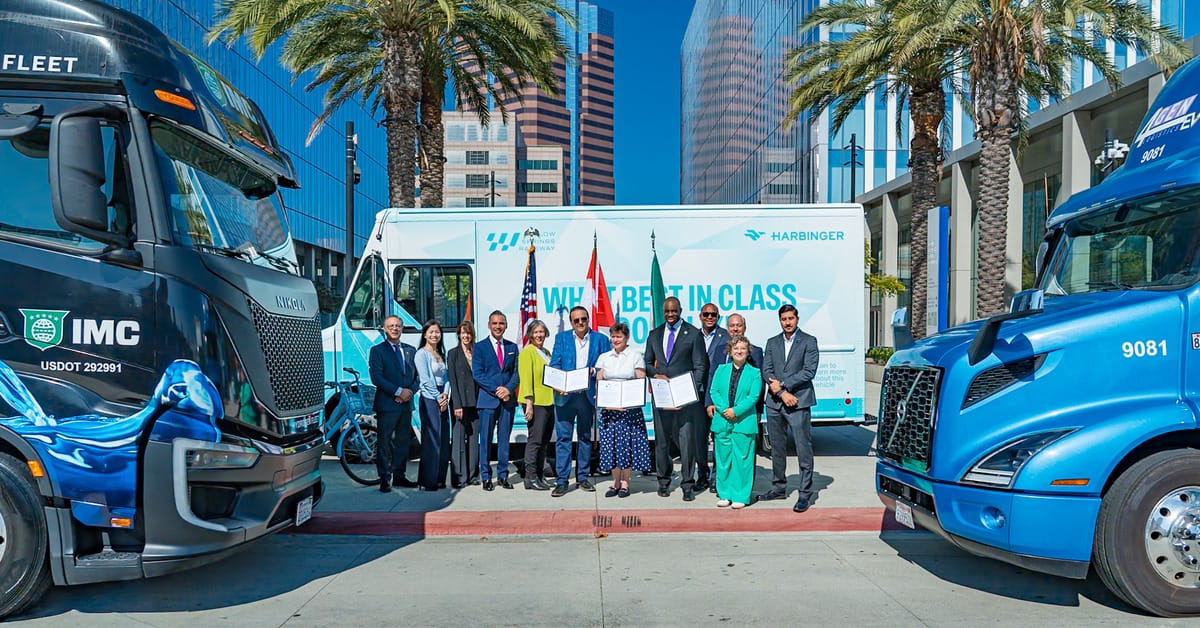
Five West Coast Governments Launch BC2BC Zero-Emission Truck Corridor Along I-5
Representatives of California, Oregon, Washington, British Columbia and Baja California launched a coordinated zero-emission truck corridor along Interstate 5 at a ceremony and zero-emission truck showcase at the Port of Long Beach on 26 August. The British Columbia to Baja California Zero Emissions Vehicle Corridor — BC2BC — is designed to let battery-electric heavy-duty trucks charge and run the length of the West Coast, from Vancouver to Baja California, with an initial buildout of 20 electric charging stations and three hydrogen stations.
I-5 runs roughly 1,380 miles from the Canadian border at Blaine, Washington, to the Mexican border at San Ysidro, California, crossing two international borders and five jurisdictions, each with its own utility interconnection processes, permitting paths, incentive programs and equipment standards. The five governments committed to harmonizing the technologies along the route as well as the planning behind it.
A statement of principles, not a construction deal
What the five governments signed is a statement of principles — not a funding award, a construction schedule or a site plan. The announcement names no locations, operators, power levels or completion date. According to CALSTART, the document is meant to ensure alignment and interoperability "while also increasing future returns on investment and maximizing decarbonization benefits." The practical work ahead is jurisdictional: the governments agreed to harmonize technical standards and planning through a series of technical meetings that will follow the launch.
Why the corridor matters
I-5 is one of the busiest freight corridors in the United States, averaging nearly 10,000 trucks a day — sometimes as many as 35,000 — moving agricultural products, lumber, consumer goods and other cargo. About 550 miles of the route pass through urban areas such as Los Angeles. Heavy-duty trucks account for just 6 percent of vehicles on California roads but roughly 35 percent of nitrogen oxide emissions and 25 percent of greenhouse gas emissions from vehicles, according to the California Air Resources Board. The goal is to have Class 8 heavy-duty electric trucks run the entire corridor as soon as 2030.
"Today marks the beginning of something extraordinary — a tri-national, five-state partnership to deploy charging infrastructure along Interstate 5," said California Transportation Secretary Toks Omishakin. "This initiative will help create a more seamless, reliable zero-emission freight corridor than ever before."
"Freight corridors are where electrification can deliver real operational value at scale," said Aravind Kailas, advanced technology policy director at Volvo Group North America. "By aligning charging infrastructure, technical standards, and planning across jurisdictions, the BC2BC initiative can give fleets greater confidence to plan routes, maintain uptime, and make long-term investment decisions."
Coordination and participation
CalSTA, CALSTART's Drive to Zero campaign and the Institute of Transportation Studies at UC Davis are coordinating planning and investment. Named participants include Volvo Group North America, Southern California Edison, Tesla, EV Realty, King Fio Trucking, IMC Logistics and ZM Trucks.
Similar corridors are at various stages of development elsewhere, including an 800-mile East Coast route on I-95 between the Port of Savannah and the Port of New York and New Jersey, a 250-mile corridor between Rio de Janeiro and São Paulo, and a 740-mile route between Bogotá and Cartagena, Colombia. Stephanie Kodish, senior global director of the Global Drive to Zero Campaign at the nonprofit CALSTART, called the West Coast corridor "one of the world's most ambitious examples."
"What makes it so important is not just its scale, but that it demonstrates how governments can align policy, infrastructure planning and industry engagement across borders to accelerate the transition," she said.
Sources
- ACT News: West Coast States Announce Launch of I-5 ZEV Corridor — published 27 August 2026
- Los Angeles Times: Electric heavy-duty trucks will be able to run from Baja to Canada, West Coast leaders pledge — published 27 August 2026