Not Just an Experiment: Why Hydrogen Combustion Engines Are Going to Work in Heavy Construction
For the past five years, the dominant narrative around zero-emission construction equipment has been battery-electric. And for the sub-30-tonne segment, that narrative holds: electric excavators, wheel loaders, and compactors are entering production, the charging infrastructure is growing, and fleet managers are placing orders.
But above 30 tonnes, the story changes. A 50-tonne excavator operating an eight-hour shift demands roughly 400–600 kWh of energy storage. At current battery densities, that means adding 4 to 6 tonnes of batteries — weight that eats into payload, stresses undercarriages, and extends charge times beyond practical limits. Hydrogen, in contrast, adds a fraction of that weight and refuels in 10–15 minutes.
That is why three of the world's largest construction equipment manufacturers — JCB, Liebherr, and Caterpillar — are all betting on hydrogen internal combustion engines (H2 ICE) for heavy machinery. Not as a side project. As a production strategy.
JCB: First to Market, First to Certification
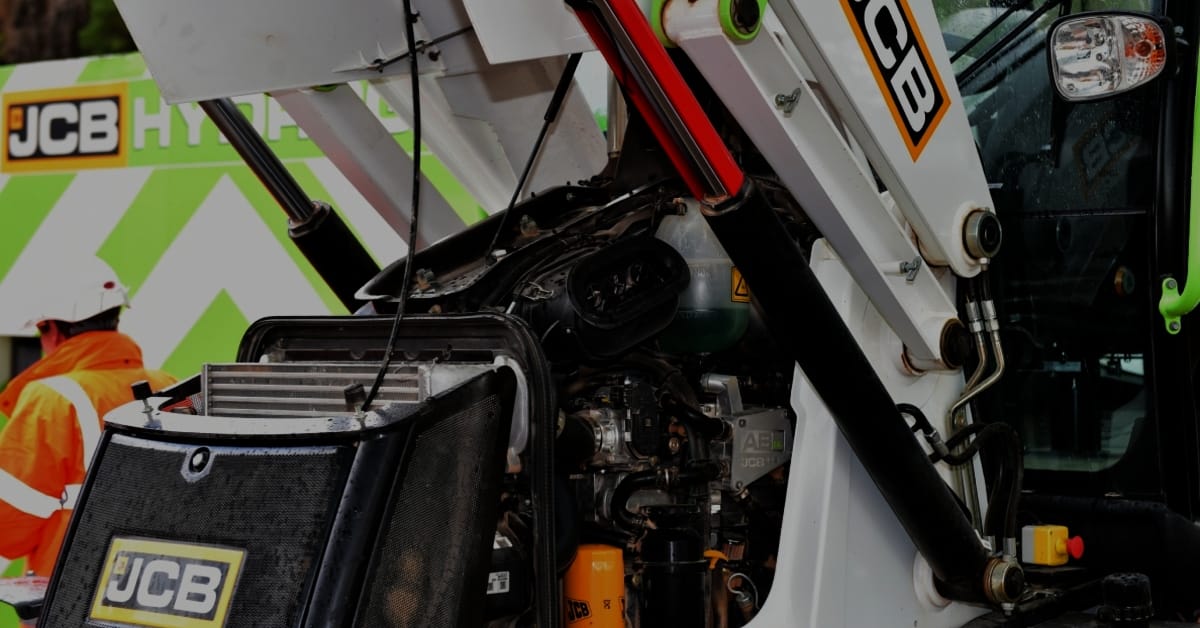
JCB is the furthest along. The British manufacturer has invested £100 million and deployed a dedicated team of 150 engineers to develop the world's first production-ready hydrogen combustion engine for off-road machinery. The engine is a 4.8-litre, four-cylinder spark-ignited unit that burns hydrogen instead of diesel, producing zero CO₂ at the tailpipe — only water vapour.
By January 2025, JCB had secured commercial certification from 11 European national licensing authorities, led by the Netherlands' RDW. Later that year, the company achieved a landmark: full EU type approval under Regulation (EU) 2016/1628 (Stage V) for non-road mobile machinery — the first hydrogen combustion engine ever to receive it. The approval extends across all 27 EU member states and territories that recognise EU standards.
The company has already built more than 130 evaluation engines, powering backhoe loaders, Loadall telescopic handlers, and generator sets on real customer sites. JCB Chairman Lord Anthony Bamford framed the achievement bluntly: *"It was not so long ago that some said it was 'game over' for the internal combustion engine in Europe. To have secured full EU type approval is proof positive that the combustion engine does indeed have a promising future."*
JCB has also demonstrated the engine's versatility by retrofitting it into a 7.5-tonne Mercedes truck, signalling that the technology can scale beyond construction machinery into light goods transport.
Liebherr: A 50-Tonne Machine, a 13-Litre Hydrogen Heart
Liebherr took a different but equally significant path. At Bauma 2022, the Swiss-German group unveiled the R 9XX H2 — a 50-tonne crawler excavator powered by its own H966 hydrogen combustion engine. The machine won the Bauma Innovation Award and has since undergone extensive field trials in quarries and earthmoving operations.
The H966 is a 13-litre, six-cylinder hydrogen engine using port-fuel injection (PFI). Liebherr reports that it delivers identical overall performance to the diesel equivalent — same power output, same engine dynamics, same response — while cutting CO₂ by nearly 100 percent on a tank-to-wheel basis, or roughly 70 percent cradle-to-grave depending on hydrogen production methods. NOx emissions are extremely low and are managed through lean-burn combustion strategies.
The R 9XX H2 shares the same Generation 8 platform as Liebherr's diesel crawler excavators, which means operators and service technicians face minimal learning curve. Refuelling is handled via infrared communication between machine and station, following standardised high-speed protocols — fill times are comparable to diesel.
Liebherr Components, the division behind the H966, has also announced development of direct-injection hydrogen variants, which offer higher power density and are particularly suited to heavy-duty mining and construction applications. Series production of hydrogen engines was originally targeted for 2025, with multiple customer pilots underway.
Caterpillar: Platform Strategy for a Hydrogen Future
Caterpillar's approach is the broadest. Rather than developing a single hydrogen machine, the company is building its next-generation engine platform — the Cat C13D — with hydrogen capability baked in from the start.
The 13-litre, inline six-cylinder C13D delivers 456–690 horsepower (340–515 kW) and up to 3,200 Nm of peak torque — a 20% power increase and 25% more low-speed torque over its predecessor. It won the Power Progress Engine of the Year Award in 2024. Production is scheduled for 2026.
The hydrogen pathway runs through Project THOR (Hydrogen Hybrid Power Solution for Off-Highway Vehicles), a three-year programme co-funded by the U.S. Department of Energy and launched in early 2024. The project aims to demonstrate a transient-capable hydrogen-hybrid system that matches or exceeds diesel power density using advanced control architectures and electric-hybrid components.
Caterpillar is also fielding hydrogen-fuelled Cat generator sets capable of running on 100% hydrogen — a signal that the company sees hydrogen as a fuel applicable to stationary and mobile power alike. At Bauma 2025, the company displayed a live hydrogen engine test bay on its stand, underscoring that this is not a PowerPoint exercise.
H2 ICE vs. Fuel Cells: The Right Tool for the Right Job
One of the most persistent questions in the hydrogen debate is *combustion or fuel cell?* Industry data from Energy Solutions and independent drivetrain studies offers a clear breakdown:
- **H2 ICE** achieves 32–38% real-world efficiency (40–44% peak) and reduces greenhouse gases by 70–90% when fuelled by green hydrogen. Capital expenditure is 1.2–1.4× that of a diesel baseline.
- **Fuel cells (FCEV)** achieve 45–55% real-world efficiency (55–60% peak) with similar GHG reductions. But capex runs 1.7–2.2× diesel.
For construction, agriculture, and mining — where machines operate in dust, extreme temperatures, and shock-heavy environments — H2 ICE scores 8–9 out of 10 on suitability. The technology is robust, the maintenance is familiar, and the drivetrain is already understood by every mechanic on site. Fuel cells offer higher efficiency, but at higher cost and with greater sensitivity to operating conditions.
The consensus among OEMs and analysts is that the two technologies will coexist: fuel cells for long-haul corridor operations where efficiency matters most, and H2 ICE for off-road heavy equipment where ruggedness and low upfront cost are decisive.
The 50-Tonne Problem
The practical argument for hydrogen in heavy construction is best illustrated by a single number: energy density. Hydrogen stores roughly 33.3 kWh per kilogram — 100 times more than a lithium-ion battery on a mass basis. A 50-tonne excavator operating an eight-hour shift requires roughly 400–600 kWh. A battery pack of that capacity weighs 3–6 tonnes and takes hours to recharge. Hydrogen tanks for the same energy weigh roughly one-tenth of that and refuel in 10–15 minutes. For machines that operate around the clock in quarries, demolition sites, and mining operations, that difference is decisive.
The Defense Dimension
Heavy-Shift covers the intersection of civil heavy equipment and defence technology, and hydrogen adds a relevant layer here. Military logistics commands from multiple NATO countries have begun evaluating hydrogen-powered heavy machinery for forward operating bases and garrison operations. The rationale mirrors what civilian fleet managers are discovering: reduced fuel convoy vulnerability, lower thermal and acoustic signature compared to diesel, and compatibility with on-site electrolysis in deployed settings.
Hydrogen combustion engines can be maintained using the same skill sets and tooling as diesel engines — a critical advantage in military logistics where technical support is already stretched.
Where Things Stand in Mid-2026
JCB is selling hydrogen-powered machines across Europe. Liebherr is conducting customer field trials with the R 9XX H2. Caterpillar is on track to begin C13D production and hydrogen-hybrid demonstrations this year. The question is no longer whether hydrogen combustion works in heavy machinery — it does, and the certification and field data prove it.
The real constraints are hydrogen availability, distribution infrastructure, and cost. But for the 50-tonne-plus segment where batteries cannot compete, hydrogen combustion has opened a path that did not exist five years ago. And three of the industry's most important manufacturers are now committed to walking it.
---
*Sources:* - JCB hydrogen engine — EU type approval, 130 evaluation engines, £100M investment. [JCB](https://www.jcb.com/en-gb) | [Compact Equipment](https://compactequip.com/engines/jcbs-hydrogen-engine-earns-full-eu-type-approval-inches-closer-to-real-world-construction-use) - Liebherr R 9XX H2 excavator — 50-tonne, H966 hydrogen engine, 13L/6-cyl, PFI. [Liebherr](https://www.liebherr.com/en-int/components/solutions/combustion-engines/product-portfolio-diesel-engines/h966-6725400) | [Liebherr Press Release](https://www.liebherr.com/fi-fi/n/world-premiere-liebherr-debuts-crawler-excavator-with-a-hydrogen-engine-27129-4121348) - Caterpillar C13D — 13L engine platform, 456-690 hp, Project THOR hydrogen-hybrid, DOE-funded. [Cat](https://www.cat.com/en_US/news/engine-press-releases/caterpillar-powers-today-and-drives-tomorrow-at-bauma-munich-2025.html) | [For Construction Pros](https://www.forconstructionpros.com/equipment/fleet-maintenance/product/22879718/caterpillar-cat-caterpillar-launches-program-to-develop-hydrogenhybrid-power-solution) - H2 ICE vs FCEV efficiency and TCO benchmarks. [Energy Solutions](https://energy-solutions.co/articles/sub/hydrogen-combustion-engines-h2-ice-jcb-toyota-heavy-duty-strategy.html) - Military hydrogen logistics — reduced convoy vulnerability, lower acoustic signature. [Defence Research Canada](https://www.canada.ca/en/department-national-defence/programs/defence-ideas/element/competitive-projects/challenges/powering-the-future.html)